


Understanding Bond Guarantee
February 12, 2025Understand Credit Guarantee
What are bonds? What if they are guaranteed?
Bonds are debt instruments offering interest coupons with maturity date of one year or more. They are common means of financing which are categorized as Plain Bond, Secured Bond, and Guaranteed Bond. Bonds are designed to be more easily tradeable and are commonly issued by larger companies, governments, and special purpose issuers. They are also a core holding for many investors, such as insurance companies, trustees, and central banks.
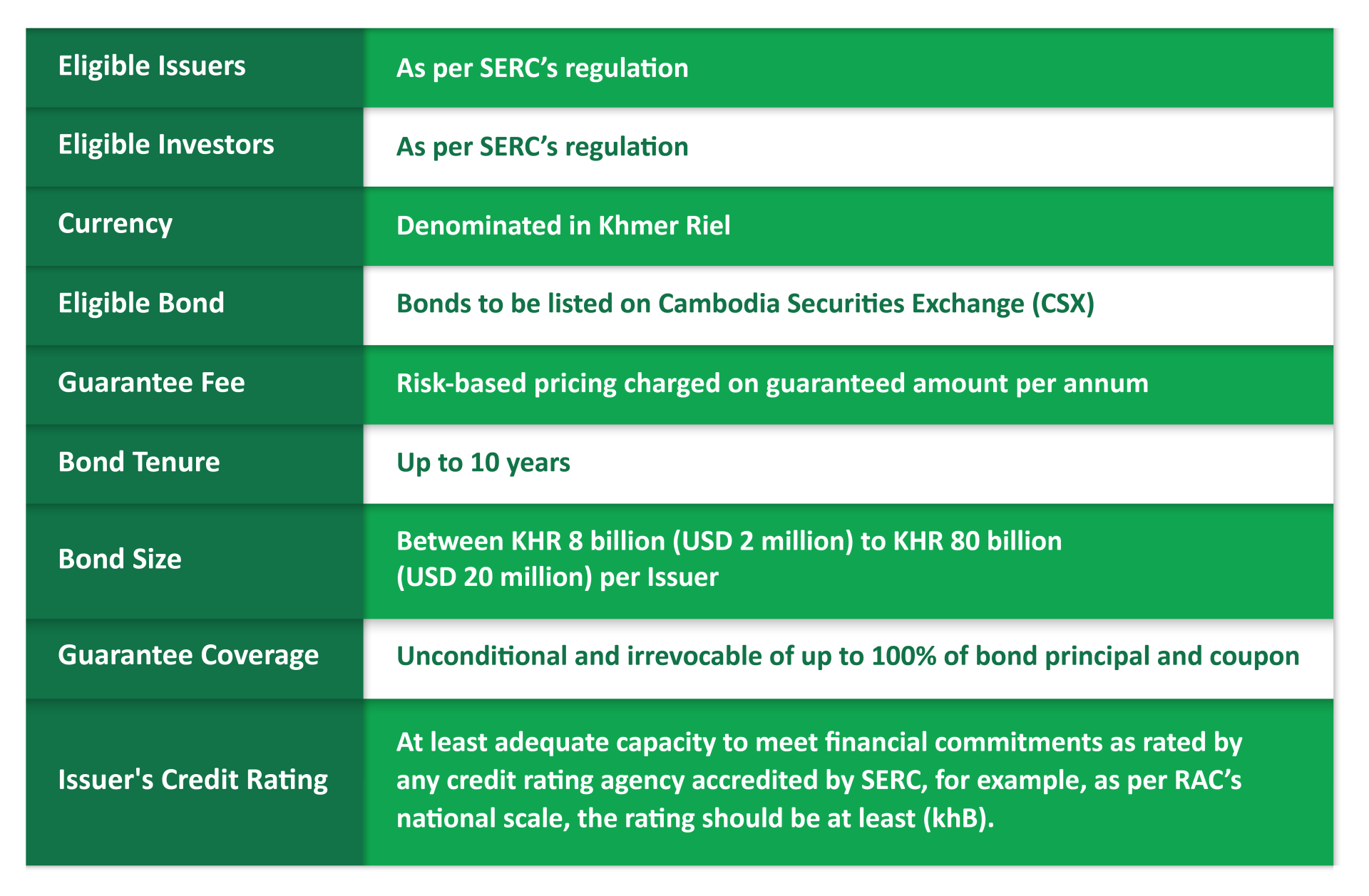
While bonds are structured with various types of coupons, in Cambodia we observe that fixed-coupon and floating-rate bonds are available in the market. Fixed-coupon bonds offer periodic uniform payments usually at monthly, quarterly, semi-annual, or annual intervals. Floating-rate bonds, on the other hand, combine a market reference rate (MRR) and an issuer-specific spread referred to as the credit spread. Bonds can be issued in many currencies. Bonds that pay both interest and principal in the same currency are called single currency bonds; bonds that pay interest in one currency but principal in another currency are called dual currency bonds. In Cambodia, bonds shall be denominated in Khmer riel but are allowed to be settled in US dollar.
Guaranteed bonds have interest and principal payments promised to be paid by a third party should the issuer default. The third party, the Guarantor, could be a government, private company, insurance company, or the parent company of the issuer. The guarantor grants bond investors with guarantee for the issuer’s credit risk being the risk of economic loss resulting from issuer’s failure to meet their timely promised interest and/or principal payment obligations over the life of the bond. This compensation could boost investors’ confidence and cause the bonds to have a lower coupon rate, but the issuer is charged for guarantee, usually at a rate based on their own risk profile. With guarantee, the bond issued would receive a credit rating as high as the guarantor’s credit rating. Thus, a bond guarantee facility offers a safer investment option for investors and a more affordable borrowing to issuers.
Nevertheless, a bond guarantee would require covenants imposed on and security packages required from issuers depending on the assessment. The guarantor assesses issuer mainly on their financial health and performance, corporate governance, and future business plan, etc. The guarantor also conducts due diligence by performing onsite visits to examine in detail the company’s financial, operational, legal, tax and other areas. Upon the completion of the process, the guarantor would be able to conclude whether the guarantee facility could be offered and with what kind of covenants and security packages. Covenants are the legal terms of debt agreements that an issuer must comply with and usually involve financial restrictions which could be a limit on leverage ratios, minimum debt service coverage ratio, and prudential ratios such as liquidity ratio, solvency ratio, NPL (non-performing loan) ratio and other ratios required by the central bank in case issuers are banking and financial institution. The security packages should be the asset quality and value supporting the issuer’s indebtedness which may include bank deposits, property, personal guarantee, sinking funds, and others. Moreover, a bond guarantee also requires a set of legal documents where the terms and conditions of the guarantee and the recourse are set out.
Whilst the bond guarantor promises to assume responsibility for a debt on behalf of the issuer, they can also seek another guarantor to split risk. This re-guarantee allows both guarantors to share part of the exposure based on their risk appetite. In Cambodia, Credit Guarantee Corporation of Cambodia (CGCC) is the first and only entity accredited by the Securities and Exchange Regulator of Cambodia (SERC) as the bond guarantor. CGCC’s bond guarantee facility includes both sole and re-guarantee. CGCC unconditionally and irrevocably guarantees 100 percent of the bond principal and interest amount on sole guarantee. In mid-2024, CGCC took an important step to foster our bond guarantee mission by initiating a strategic partnership with the Private Infrastructure and Development Group (PIDG) and their subsidiary, GuarantCo Ltd. The three institutions agreed to enter into re-guarantee transactions of bonds in Cambodia to support the local bond market development.
Since CGCC’s guarantee features extend to a minimum issue amount of only 8 billion riels (about 2 million US dollar), enterprises and corporations in need of capital could consider issuing bonds as an alternative to a bank loan. Enterprises and corporations, in consultation with their financial advisor or the underwriter, would be able to structure their bond tenor, coupon rate, repayment of principal, and other terms as per their preference. Meanwhile, CGCC does not restrict our bond guarantee to any specific sector, so application from potential issuers of any sector is openly welcomed for assessment.
Read and Download in PDF: https://www.cgcc.com.kh/wp-content/uploads/2025/06/Understanding-Bond-Guarantee.pdf